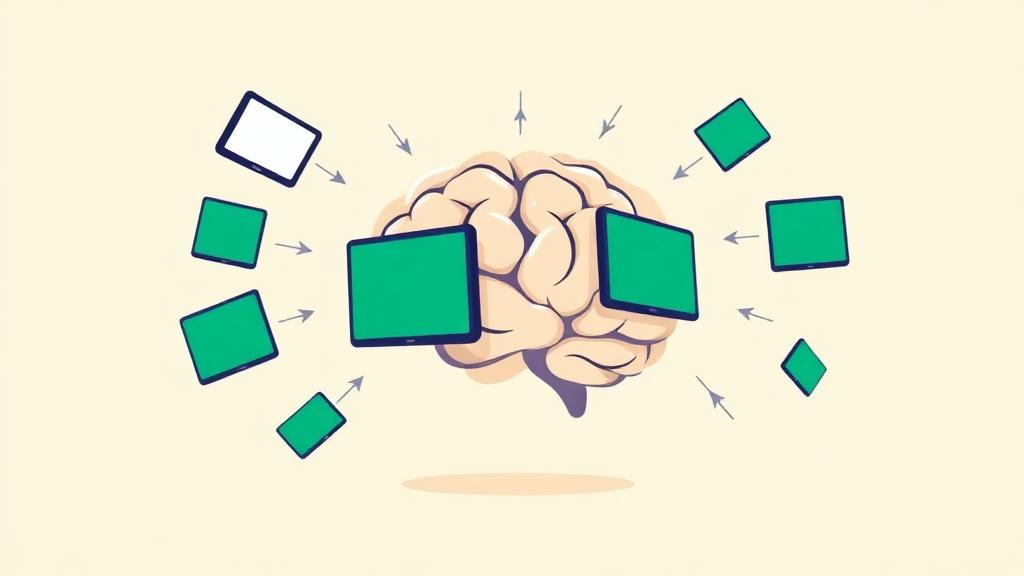
The Hidden Cost of Context Switching and How AI Solves It
Introduction
"Wait, what was I working on?" — the thought that follows every Slack notification, every quick question, every five-minute meeting.
A developer's day isn't all coding. Code reviews, meetings, Issue triage, documentation updates, chat requests. As you switch from task to task, your most valuable resource — focus — drains away in small, invisible increments.
This article quantifies the hidden cost of context switching and examines how AI — DevLoop Runner in particular — can address the problem at its root.
What Is Context Switching?
Context switching is the cognitive cost of moving from one task to another.
The term originates in computer science, where it describes the overhead when a CPU switches between running processes. The current process state is saved; the next process state is loaded. During this transition, no productive work happens. Pure overhead.
Human context switching follows the same pattern. You offload Task A from working memory and load Task B. The transition takes time, and none of that time produces output.
What the Research Shows
The cost of context switching isn't just a vague feeling of inefficiency. It's been measured.
23 Minutes to Recover
Research by Professor Gloria Mark at UC Irvine found that it takes an average of 23 minutes and 15 seconds to fully resume an interrupted task. A five-minute chat response doesn't cost five minutes — it costs close to half an hour when you factor in recovery.
The Broader Impact
The damage goes beyond lost time.
| Impact | Description |
|---|---|
| Time loss | ~23 minutes of recovery per switch |
| Higher error rate | Mistakes increase after interruptions |
| Cognitive load | Holding multiple contexts fatigues the brain |
| Increased stress | Frequent switching generates psychological strain |
| Reduced creativity | Deep thinking gets interrupted, blocking creative problem-solving |
Why Developers Are Especially Vulnerable
Software development is unusually sensitive to context switching.
When writing code, developers build intricate mental models — variable states, call hierarchies, data flows, edge cases. These models live in working memory. An interruption collapses the model, and rebuilding it takes significant time and effort.
Context Switches in a Developer's Day
A typical day reveals just how many switches occur.
Coding to Code Review
You're deep in your own implementation when a teammate requests a code review. To review their code, you need to shelve your current context and load an entirely different one. When you return to your own code, you restart from "where was I?"
Coding to Meetings
The true cost of a one-hour meeting isn't one hour. Add preparation time before and recovery time after, and the real cost approaches two hours. Worse, a meeting in the middle of the day fragments the surrounding blocks, making them too short for deep work.
Coding to Chat Requests
Responding to Slack messages looks quick — "just a minute." But each response triggers an interrupt-and-recover cycle. When the answer requires investigation, the context switch is complete.
Switching Between Issues
You're implementing one Issue when an urgent bug report arrives. Loading the bug's context, diagnosing, fixing, then switching back to the original Issue. This isn't just changing files — it's swapping out the entire mental model, including background knowledge and design decisions.
Flow State and Productivity
The opposite of constant context switching is flow state.
What Flow State Is
Psychologist Mihaly Csikszentmihalyi described "flow" as a state of complete absorption in an activity, where the sense of time disappears and productivity soars. Developers in flow can be several times more productive than normal.
Getting Into Flow Takes Time
Reaching flow state typically requires 15 to 30 minutes of uninterrupted focus. In an environment where context switches happen every 30 minutes, flow state becomes mathematically impossible.
Loading diagram...
The Value of Protecting Flow
Adding just two more hours of flow-state work per day transforms productivity. The problem is how fragile flow is. One Slack message, one notification, one meeting — a single interruption breaks flow, and another 15 to 30 minutes is needed to re-enter it.
How AI Reduces Context Switching
How can AI help developers switch less?
The "Fire and Forget" Model
DevLoop Runner's greatest advantage is that once you hand off an Issue, you can forget about it until the results are ready.
Traditional development requires loading a codebase context, designing a solution, implementing it, writing tests, and creating a PR. Throughout this process, you must hold the context in your head.
With DevLoop Runner, you pass an Issue to Dev Run and AI handles everything from design through PR creation. After handing off the Issue, you're free to focus on something else. When the PR is ready, you review it. This model eliminates the heaviest cognitive burden: maintaining implementation context.
Delegating Context
By delegating Issues to DevLoop Runner, developers reduce their own context switching load.
Traditional flow:
Implement Issue A → Interruption → Implement Issue B → Interruption → Return to Issue A (23 min)
DevLoop Runner flow:
Hand Issue A to Dev Run → Hand Issue B to Dev Run → Review Issue A PR → Review Issue B PR
In the second flow, the developer never holds implementation context. Review is a lighter-weight activity than implementation, so switching between reviews costs far less.
Shifting to Review Mode
With DevLoop Runner, the developer's role shifts from implementer to reviewer. Reviewing has a lower context-switching cost than implementing.
- Implementation requires a detailed mental model of the codebase
- Review centers on reading diffs and verifying design intent
Reviewing multiple PRs in sequence involves much less cognitive overhead than switching between multiple implementations.
Practical Strategies for Reducing Context Switching
Beyond AI, here are actionable techniques to reduce switching costs.
Time Blocking
Block "focus time" on your calendar and enforce a no-meetings, no-chat policy during those blocks.
- Designate 2-3 morning hours as "no-meeting time"
- Temporarily silence Slack notifications
- During focus blocks, hand Issues to DevLoop Runner and reserve your attention for deep-thinking tasks
Batch Similar Tasks
Group tasks of the same type and handle them in batches.
- Do all code reviews in the morning
- Respond to chat messages at set intervals
- Triage Issues once a week
Make Recovery Easier
You can't eliminate interruptions entirely. Reduce the cost of recovery instead.
- Before stepping away, leave a comment noting your next step
- Use TODO comments to mark progress
- Use descriptive branch names
Combining These Methods with DevLoop Runner
Pairing these strategies with DevLoop Runner amplifies the effect.
- At the start of a focus block, hand pending Issues to DevLoop Runner
- Spend your focus time on design work, architecture decisions, or other tasks requiring deep thought
- At the end of the focus block, batch-review the completed PRs
Making this rhythm a daily habit minimizes context switching while keeping multiple Issues moving forward in parallel.
Summary
- Context switching costs an average of 23 minutes of recovery time per interruption
- Developers constantly switch between coding, reviews, meetings, and chat requests
- Flow state is the key to productivity, but a single interruption destroys it
- DevLoop Runner's "fire and forget" model frees developers from holding implementation context
- The developer's role shifts from implementer to reviewer, lowering the cost of each switch
- Combine time blocking, batch processing, and recovery aids with AI to minimize switching
Context switching is an invisible tax. Each individual switch seems small, but accumulated over a day, the lost time and cognitive energy are staggering. Delegate what AI can handle; focus on what only you can do. That division is the key to fundamentally improving developer productivity.
Get Started with DevLoop Runner
Auto-generate PRs from GitHub Issues. Let AI accelerate your development.